
Tuscaloosa DRC Release Role
The Tuscaloosa Day Reporting Center serves Tuscaloosa County as part of the Alabama Bureau of Pardons and Paroles network. It is a reporting and supervision facility. It is not the Tuscaloosa County Jail, not an ADOC prison, and not a booking center. People do not appear on a DRC custody roster because the DRC is used after custody or as part of structured supervision, reporting, treatment, or reentry-style requirements.
The DRC matters when a release record, court order, parole decision, mandatory-supervision process, or ABPP assignment points a person into local reporting. That status can follow prison release, probation, parole, revocation handling, or another ABPP pathway. The DRC page should never be used to imply that the person is currently jailed at the address. If confinement is the question, check Tuscaloosa County Jail, ADOC, BOP, ICE, or the court depending on the case.
| Record need | Use the DRC? | Better first source |
|---|---|---|
| Current county jail custody | No | TCSO Who's in Jail and jail records |
| County jail release date | No | Sheriff prisoner book and court order |
| Local reporting assignment | Yes, when ABPP assigns it | ABPP Field Office, DRC, and public records |
| Parole board decision | Not first | ABPP hearing schedules and results |
Verify Tuscaloosa DRC Reporting
A DRC assignment should be verified from the source that created or supervises it. A court order may put a person on probation or structured local supervision. ADOC and ABPP records may show mandatory supervision or parole. The Tuscaloosa Field Office may be the best first ABPP contact when the question is broad, while the Day Reporting Center is the local reporting facility once the assignment is known.
- Identify whether the person left Tuscaloosa County Jail, ADOC prison, or another custody system.
- Confirm the release date and authority through the sheriff release record, ADOC record, or court docket.
- Look for language in the court or ABPP record that refers to reporting, day reporting, supervision, parole, probation, or mandatory supervision.
- Use the Tuscaloosa Field Office or DRC contact information to route local reporting questions.
- Use the ABPP public-records request process when a formal public record is needed.
Tuscaloosa Day Reporting Contact
The official ABPP Tuscaloosa DRC page lists the local day reporting center for Tuscaloosa County. Use the official page to confirm the address, hours, and phone before making contact. Formal records questions should follow ABPP's public-records process when the information is not available through a public hearing result, court docket, or local supervision record.
Alabama Bureau of Pardons and Paroles Tuscaloosa Day Reporting Center
220 14th Street, Unit 150
Tuscaloosa, AL 35401
Main phone: 205.872.1493
Fax: 205.394.0409
Hours: Monday-Friday, 8:00 a.m.-5:00 p.m.; closed state and federal holidays
County served: Tuscaloosa
The ABPP DRC page is a subject-fit source for this reporting facility.
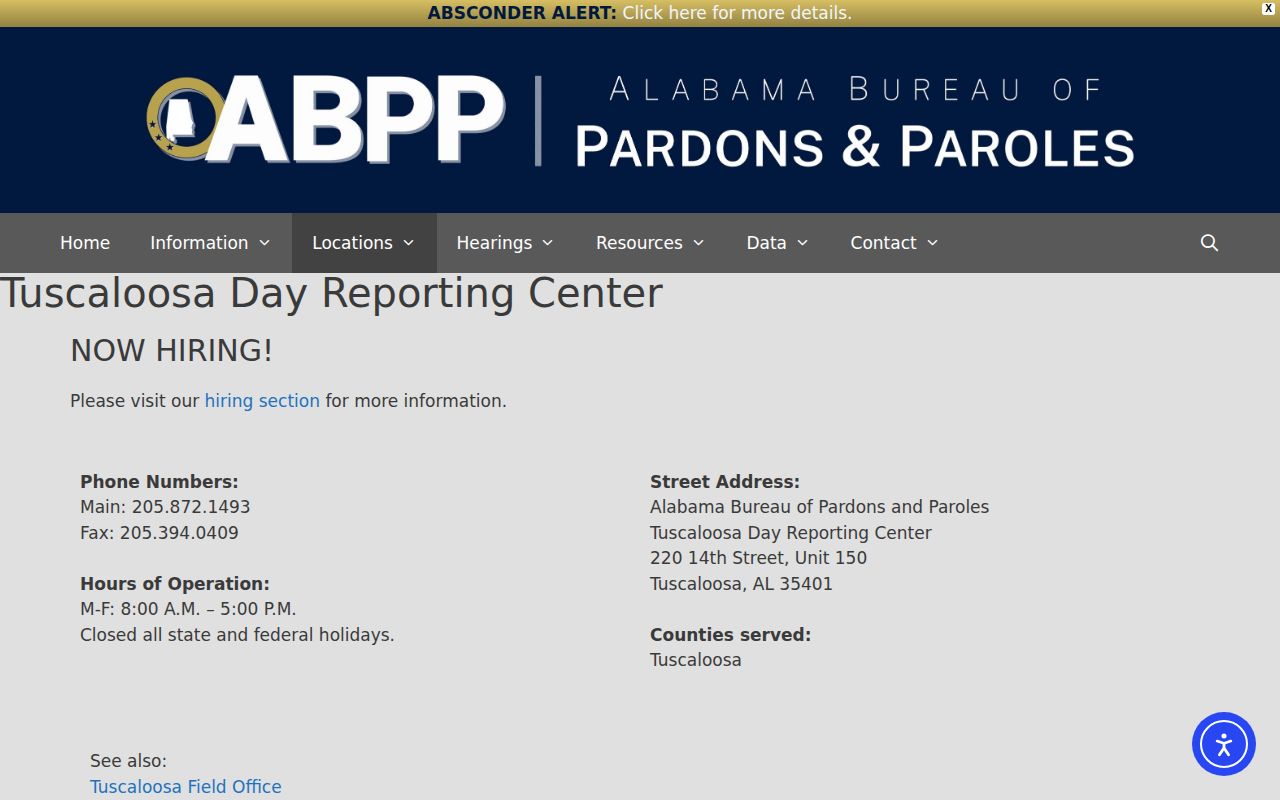
The source confirms the DRC's local reporting role without turning it into a jail roster or custody locator.
Not a Tuscaloosa Jail Roster
The DRC should not be searched like the TCSO live roster. Tuscaloosa County Jail is the local custody facility at 1600 26th Avenue. The jail has the prisoner-book release record required by Alabama law. The DRC is a supervision facility at a separate ABPP location. A person may report to the DRC after release, but that does not mean the DRC created the jail release record or that it can confirm every detail of the arrest, booking, bond, or court disposition.
If the person was just released from county jail, start with TCSO and the court. If the person was released from ADOC, remember that ADOC's standard public search is current-custody focused and may not keep historical released-prisoner data online. If the person is under supervision, use ABPP records and the local office network. If the person may be federal or immigration custody, use BOP, USMS, ICE, or the court case path.
- Day reporting
- A structured local reporting requirement after or instead of physical custody.
- Parole
- Supervision after release from prison by parole authority.
- Probation
- Court-ordered supervision tied to a sentence or case disposition.
- Absconder
- A supervision status alleging the person failed to remain available to supervision.
Field Office and DRC
Tuscaloosa's ABPP map is unusually clear because the Field Office and the Day Reporting Center are in adjacent units on 14th Street. The Field Office serves Tuscaloosa County for local parole and probation supervision routing. The Day Reporting Center serves Tuscaloosa County for day-reporting and structured reporting functions. They work within the same state agency, but the record path can differ by question.
Use the Field Office when the broad question is whether the person is under local ABPP supervision or which office serves the case. Use the DRC when a record, order, or ABPP instruction points to day reporting. Use court records when the question is why the person was released or what conditions were imposed. Use TCSO when the question is the county jail release date, booking record, or release order from the jail.
Because both offices share a 14th Street location area, address similarity should not be confused with function. Unit 100 is the Field Office. Unit 150 is the Day Reporting Center. A person may have contact with one, both, or neither depending on the release terms. The best record practice is to keep the office name, unit number, phone number, and record type together when making notes or requests.
For the larger explanation of local supervision, use Post-Release Supervision. For the county jail release itself, use Tuscaloosa County Jail.
Tuscaloosa DRC Records Route
Formal DRC-related records should be requested through the custodian that holds the record. ABPP provides a public-records request page with forms, instructions, procedures, and the public.records@paroles.alabama.gov address. Court records remain the source for sentencing, probation orders, revocations, and case dispositions. TCSO remains the source for jail custody and release from Tuscaloosa County Jail.
That layered route helps avoid false negatives. A person may have no current jail record because they are out of custody. They may have no ADOC current-inmate result because they are not in prison. They may not appear in an absconder alert because they are reporting as directed. The DRC becomes relevant only when the supervision record points there.
When submitting a request, name the specific record sought. For a jail release, ask TCSO for the prisoner-book release fields. For a probation order, use the court. For ABPP reporting or parole supervision, use ABPP. For a state-prison minimum release date, use ADOC while the person is currently incarcerated. Clear routing prevents the DRC from being treated as a catch-all office for records it did not create.
Note: A DRC reporting assignment is part of post-release supervision; it is not a replacement for the jail release record.
Reporting After Release
Day reporting is a practical release detail, not just an address. It can mean the person must appear at set times, follow local instructions, participate in supervision programming, or satisfy conditions imposed by a court or ABPP. The public sources do not publish individual reporting schedules, so those details should be verified through the supervising authority and the person's official paperwork.
A missed reporting requirement can lead to court or supervision consequences, but the public record must still be read with care. An absconder alert, revocation order, or warrant has a different meaning from a normal reporting assignment. Use ABPP's absconder alerts only for the status it publishes, and use the court docket or ABPP records for the order behind any change.
The DRC also helps separate release from reintegration. A person may be out of physical custody but still have structured local requirements. That can confuse anyone who expects the live jail roster to answer every post-release question. The jail roster answers custody. The DRC assignment answers reporting. The court and ABPP records explain the authority behind the reporting requirement.
For Tuscaloosa County, the strongest verification method is a short record chain. Confirm the release event with TCSO or ADOC, confirm the legal order with the court or ABPP hearing record, and then confirm whether the DRC is the assigned reporting location. If one link is missing, use the agency that created that link rather than treating the DRC as the source for all release facts.
That approach also protects against mixing two different people with similar names. A DRC question should be tied to the case number, supervision source, and release event whenever possible. If the only known fact is that a person may have reported at the DRC, first confirm the court or ABPP record that created the reporting requirement, then use the DRC contact details for local routing.